Showing posts with label baby play. Show all posts

10 favourite books for babies and toddlers

Dec 2, 2014


Having trouble during nappy change time with a wriggly baby? Try BabyLove Nappy Pants - with no tabs to contend with, the 360-degree stretchy waist allows you to pull them up quickly and easily, so your active toddler can get back to action in no time! Request a sample.

Reading with your children begins from birth and carries on over a lifetime. In the early days, baby really isn't going to know what you're reading to them. They are busy listening to your voice and tone and learning about the rhythm and sounds of language. Most importantly they are spending precious time bonding with you. Reading daily with and to children increases their early literacy skills and is more likely to grow a lifetime lover of books.

As they grow, babies begin to understand more and more. The majority of books that we loved at this early age tended to:

  • have short, simple text (often repetitive and/or rhyming)
  • allow children to attempt to mimic sounds 
  • have bright, clear or contrasting picture
  • allow children to touch or interact with the book in some way (lift flaps, touch different textures, press buttons for sound etc.)
  • feature animals or familiar people (like family)
  • be available in board books (babies and toddlers need to be able to touch and handle the books too so you'll save lots of tears and sticky-tape by getting board books they can actually use without destroying. Cloth books are especially good for infants)

Continue reading...


7 favourite Baby Play ideas

Nov 11, 2014


Having trouble during nappy change time with a wriggly baby? Try BabyLove Nappy Pants - with no tabs to contend with, the 360-degree stretchy waist allows you to pull them up quickly and easily, so your active toddler can get back to action in no time! Request a sample.


Although my baby has recently turned 3, among my circle of friends there seems to be a baby boom happening. Lots of gorgeous new little people joining our lives and entering our hearts. What a blessing! To celebrate, here are a collection of 7 baby play ideas that both my children loved. These activities are generally suitable from when baby has developed their head control and is sitting up (approx. 6 months onwards) and all require supervision.

Continue reading...


8 Homemade toys for Babies

Oct 15, 2014


Having a baby (especially your first) can be an overwhelming experience. The world of BABY/KID STUFF is an extensive one, full of items you never knew you "needed" or even existed.

When it comes to entertaining your baby, the most wonderful toy for them is you. 

Watching you, listening to you, touching you. Time with you and other caring people is invaluable for their development.

There are also many fabulous pre-made toys and items for babies that in addition to the company of you and others, can help entertain, stimulate, sooth and aid in their development. 

There are so many things out there that you could be continually buying something new, however it's just not necessary. 

Often, with many of the toys marketed towards babies, they are able to use them very limitedly before they either out-grow or get bored by them. 

This is where making your own toys can be beneficial as you can provide new and stimulating items for them, often for a very low cost (sometimes completely free) and little effort.
Continue reading...


6 ways for Baby to Play

Jul 23, 2014

Follow us on Pinterest for tons of great kids activities and ideas.


Welcome to TUESDAY TOTS. Apologies that it is late this week (again). I really should call it Wednesday Tots, haha. 
Brought to you weekly by Learn with Play at home (that's us), Rainy Day Mum and One Perfect Day.


This week we are showcasing

"6 Play Ideas for Babies"

There are a million and one "baby toys" available in the shops. That should be enough to keep baby entertained and learning, right? Shame my babies were never really interested in the colourful plastic that kept showing up at our house, and the uses of many were so limited that it's no wonder they never really captured their attention. There are so many ways that babies can play and learn from the materials you already have in your house or can buy cheaply from craft shops. (They usually find them much more exciting as well.) Here are 6 interesting ideas for babies that will keep them entertained and more importantly will aid in practicing a variety of different skills and learning areas.  **As with all activities involving young children, be sure to supervise.

Continue reading...


Simple DIY colour sorting and fine motor activity

Feb 22, 2014


As a way for my son to learn to identify colours, practice sorting and further develop his fine motor skills, I made up this quick and easy DIY colour sorting game using a recycled ice-cream container. If you don't have one, you'll have to eat some ice-cream. All in the name of parenting of course.


Age6 months- 2 years +
(N was approx 18 months here. See bottom for tips to simplify or extend to meet your child's needs)

Continue reading...


Baby and Toddler Box Play

Aug 10, 2013


Ageapprox. 6 months to 2+ years (see bottom for tips)
(N was approx 13 months here. See bottom for tips to simplify or extend to meet your child's needs)


Continue reading...


Baby and Toddler Play: Paper Plate Painting

Jul 29, 2013


Ageapprox. 6 months to 2+ years (see bottom for tips)
(N was approx 13 months here. See bottom for tips to simplify or extend to meet your child's needs)

Continue reading...


10+ ideas for keeping Tiny Tots Entertained and Learning

Apr 30, 2013


Welcome to  TUESDAY TOTS for this week.
Brought to you by Learn with Play at home (us), Rainy Day Mum
Growing a Jeweled Rose and In Lieu of Preschool

This Week:
Learn with Play at home is featuring

7 great posts for Tots
(and sharing 3 of our own to make 10 in total)


These great posts all came from last weeks Tuesday Tots linkup
where we featured Hands-On Number Activities for Kids


FEATURED

With reasonably short attention spans, our littlest friends can be tricky to keep busy, entertained and learning. I find that I need a whole host of easy activity ideas up my sleeve that I can call on at any time.
Here are some great posts for you that should give you a few more ideas for how to keep those Tiny Tots amused!

Click on the Photos to be taken to the Activity

Continue reading...


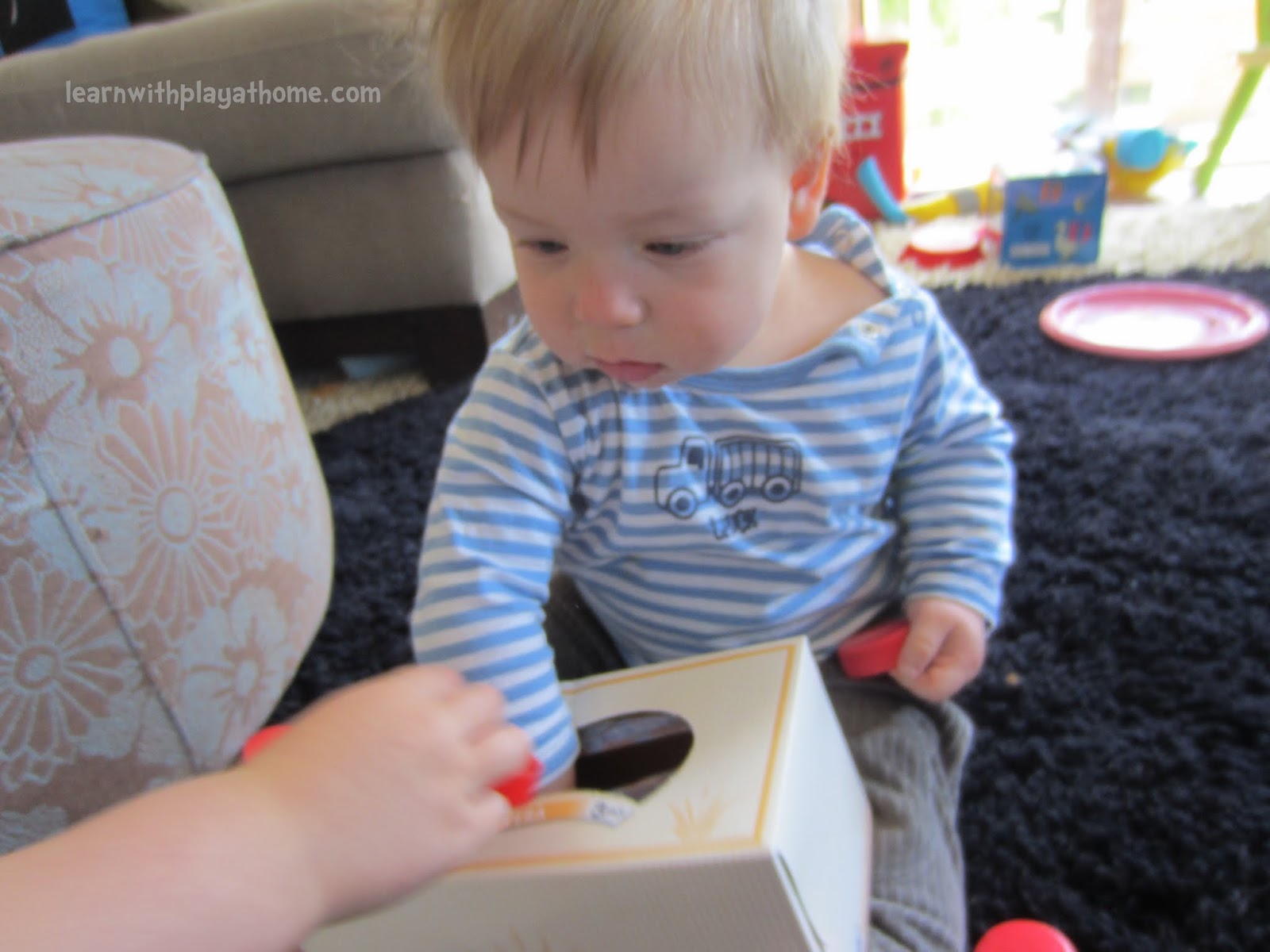
Baby Play: Tissue Box Play

Jan 6, 2013


Ageapprox. 6 months to 2 years (see bottom for tips)

Materials: Cardboard Tissue Box and Milk bottle lids
(N is currently 13 months. See bottom for tips to simplify or extend to meet your child's needs)

Set up as an "Invitation to Play" Different coloured Milk Bottle Lids on a plastic tray and a Tissue Box


Woah! What to do first? Stimulated by the different colours and bits and pieces


Tipping the tray. Learning about gravity.


Using fine motor skills and hand-eye coordination to put the milk bottle lids in the tissue box.


Where have the milk bottle lids gone? You can hear them when you shake the box. 
Reaching for the lids and learning about object permanence.


Baby is Learning:

- Fine motor skills
- Pincer grasp (picking up small objects with thumb and pointer finger)
- Hand and eye coordination
- Cause and effect (ie. tipping the tray will make the bottle lids fall off. Shaking the tissue box with lids inside it makes a rattle sound etc.)
- Shapes. The milk bottle lids are round. The tissue box is rectangular with angles and corners.
- Colours. The milk bottle lids are all the same shape/size but different colours.
- Emotions. Excitement, anticipation and enjoyment.
- About Gravity. Physical items fall down and always tip to the lowest point
- Language from the interactions you have with baby
- What to do with the materials. Put the milk bottle lids in the tissue box. Get the out again. etc
- Object Permanence. Just because you can't see it any more doesn't mean it's not there.


Handy Tips:

Simplify this activity by ensuring that the opening of the tissue box is large and easy for baby to put things inside. Allow baby to explore the materials without pushing the need to post them inside the tissue box. Pop some in the box for baby to shake and rattle and see if they can get them out.

Extend this activity for older babies by sorting the milk bottle lids into colours. Ask baby to put the "blue" milk bottle lids in the tissue box etc.

Mix it up by providing some items that are too big to fit inside the tissue box. Let baby experiment and figure this out.

Repeat this activity as often as you like because babies (& children) need repetition to consolidate their learning and understanding. 

Talk to your baby about what they are doing. This will help them begin to understand the physical and mental processes they are going through as well as helping develop their vocabulary. "You have a red lid", "Where have the lids gone? Shake, shake, shake. What is that sound, baby?" 

Play with baby. Once they have explored on their own and been given an opportunity to discover on their own, you could show them how to put the lids into the tissue box or how you get them out.

Supervise. Babies need constant supervision.


Click here for MORE BABY PLAY IDEAS


Happy playing,
Debs :)


New Here? Subscribe to get all activities sent directly to you
Enter your email address:


Delivered by FeedBurner


Continue reading...


Baby Play: Pompom Play

Oct 12, 2012

baby activity, baby play


Ageapprox. 6 months to 2 years (see bottom for tips)

Materials: Plastic tub, pompoms, spoon
(N is currently 11 months. See bottom for tips to simplify or extend to meet your child's needs)


Present tub of pompoms with props (spoon) to baby ensuring you stay with them while they play
(note: pompoms are small and could be a choking hazard without proper supervision)


What will baby reach for first. The pompoms or the prop that stands out as being different?


Exploring different colours, textures, sizes and shapes


Fantastic for practicing fine motor skills and hand eye coordination. 
Can baby pick up one using the pincer grip (thumb and pointer), pass the pompom from one hand to the other? etc


Tip the container Baby. Watch the pompoms slide from one side of the tub to the other.


Baby is Learning:

- Fine motor skills
- Pincer grasp (picking up small objects with thumb and pointer finger)
- Hand and eye coordination
- Cause and effect (ie. tipping the tub up will make all the pompoms slide to the lower side)
- Textures and the difference between hard and soft
- Colours. Look how all the pompoms are the same but different
- Emotions. Enjoyment & excitement.
- About Gravity. Physical items fall down and always tip to the lowest point
- What to do with this materials. Scoop or stir with the spoon. Pick up, swish, throw the pompoms
- Sensory. Feel of the pompoms, how they are fuzzy and soft and squishy but can't be squished completely (unlike the baked bean baby play) as well as the smell, temperature (neither hot nor cold) and appearance.


Handy Tips:

Simplify this activity by providing the pompoms in a container without the spoon. Younger babies will probably not be at stirring or scooping stage, however touching and feeling the comparison between the 2 different materials is also good learning for baby.

Extend this activity for older babies by providing extra props to use with the pompoms. Try adding a little bowl, cup, tongs etc for more scooping, pouring, pretend play and fine-motor skills

Mix it up by trying as toddler pompom push instead

Repeat this activity as often as you like as babies (and children) need repetition in order to consolidate their learning and understanding. 

Talk to your baby about what they are doing. This will help them begin to understand the physical and mental processes they are going through as well as helping develop their vocabulary. "The pompoms feel soft and squishy and fuzzy!" "Look at the yellow pompom, baby" 

Play with baby. Once they have explored on their own you can show them how to stir or swirl around the pompoms. 

Supervise. Babies need constant supervision.


Click here for MORE BABY PLAY IDEAS


Happy playing,
Debs :)


New Here? Subscribe to get all activities sent directly to you
Enter your email address:


Delivered by FeedBurner
Continue reading...


Baby Play: Sensory Baked Bean Squish & Snack

Sep 12, 2012


Ageapprox. 6 months to 2 years (see bottom for tips)

Materials: Baked beans (half cold and half luke warm)


Place 2 piles of baked beans in front of baby. One cold and one warm 
(not hot, we don't want to burn baby!)


Let baby feel and experience the sensory aspects of the beans.


Use this activity at snack time. 
Babies will always put things in their mouths (food or not!) so ensure your baby is fine to eat baked beans.


Look at the swirls and patterns you can make, baby.


Baby is Learning:

- Fine motor skills
- Pincher grasp (picking up small objects with thumb and finger)
- Hand and eye coordination
- Cause and effect (ie. applying pressure to the beans will cause them to squish)
- About temperature. The difference between warm and cold.
- Taste and textures
- Emotions. Enjoyment & excitement.
- What to do with this material
- Sensory. Feel of the beans and slimy sauce (texture, temperature etc) as well as the smell, taste and appearance.


Handy Tips:

- For younger babies that should not be eating things like baked beans, substitute them with a rice cereal or pureed fruit/veg.

Extend this activity for older babies by talking about the difference in temperatures and finding other items that they could handle that feel both warm and cold.

Mix it up by trying a variety of different foods that are suitable for your baby. Try with items of different consistencies, textures, tastes, temperatures etc.

Repeat this activity as often as you like as babies (and children) need repetition in order to consolidate their learning and understanding. It's handy because babies need to eat so you can try something different each snack time.

Talk to your baby about what they are doing. This will help them begin to understand the physical and mental processes they are going through as well as helping develop their vocabulary. "That feels so squishy!" "Swirling round and round. Look at the patterns" 

Play with baby. Once they have explored on their own you can show them how to draw and swirl patterns and draw little pictures in the sauce. 

Supervise. Babies need constant supervision.

- ***Allergies. Please consult your family pediatrician, doctor, nurse, midwife etc if you have any concerns about what your baby should be ingesting and when is the right time for them. It is up to you to determine if this activity would be suitable for your baby or not.***


Click here for MORE BABY PLAY IDEAS


Happy playing,
Debs :)


New Here? Subscribe to get all activities sent directly to you
Enter your email address:


Delivered by FeedBurner

Are you on Facebook? We are and we'd love to see you there. You can also find us on PinterestTwitter  and G+ too. :) 


Continue reading...


Baby Play: Rat-a-tat Tins

Jul 15, 2012


Ageapprox. 6 months to 2 years

Materials: Cake tins of varying sizes/shapes, things for banging (wooden spoon, maraca etc.)


Set out some cake tins around baby and provide them with something to bang. 
Let them explore themselves.


Let baby bang with their hands and various other materials to see the difference in sound


Baby is Learning:

- Fine motor skills
- Gross motor skills
- Hand and eye coordination
- Cause and effect (ie. hitting the tin makes a sound)
- Expectation
- About sounds
- Different things make different sounds
- Beats and rhythm
- Emotions. Enjoyment & excitement.
- What to do
- Sensory. Feel of the metal, different textures on the tins, smoothness of the wood, sounds etc


Handy Tips:

Simplify this activity by sitting baby on your lap and giving them something to bang on a tin

Extend this activity for older babies by changing some of the metal tins for plastic. What's the difference in sound? See the different sounds made when the tin is empty or full. What happens when you hit the tin hard or soft? Does the size of the tin make a difference?

Mix it up by encouraging baby to try hitting the tins with lots of different materials, from hard things to soft materials. So many different sounds can be made with the same tins.

Repeat this activity as often as you like as babies (and children) need repetition in order to consolidate their learning and understanding

Talk to your baby about what they are doing. This will help them begin to understand the physical and mental processes they are going through as well as helping develop their vocabulary. "Wow, that was a loud sound!" "Listen to the rhythm baby"

- Play with baby. Once they have explored on their own you can show them what hitting the tins in different ways can do and have rock band together! Just have fun!

Supervise. Babies need constant supervision.


Happy playing,
Debs :)


New Here? Subscribe to get all activities sent directly to you
Enter your email address:


Delivered by FeedBurner

Are you on Facebook? We are and we'd love to see you thereHey, we're also on Twitter now too. :)


Continue reading...


Baby Play: Water Tray Play

Jul 6, 2012


baby game, baby activity, baby fun


Ageapprox. 6 months to 2 years

Materials: Waterproof high-chair tray or other large tray that could hold approx 1cm water & milk bottle tops.


baby game, baby activity, baby fun
Pour approx 1cm (or less) of water in baby's high chair tray (or other tray) and let baby touch and play with the water


baby game, baby activity, baby fun
Baby can barely see the water but it is there. Time to get a close look


baby game, baby fun, baby activity
Baby loves splashing! This is exploring the properties of water.


baby game, baby fun, baby activity
Add some milk bottle tops. They float and glide across the surface like a baby air-hockey table


baby fun, baby game, baby activity
Trying to grasp the milk bottle tops can be tricky, as touching them makes them glide away quickly


Baby is Learning:

- Fine motor skills
- Co-ordination
- Eye tracking (following an object with their eyes)
- Hand and eye coordination
- Cause and effect (ie. hitting the surface of the water makes it splash up and wet you etc.)
- Expectation
- About things that float
- About reflecting light
- About the see-through nature of water
- Emotions. Enjoyment & excitement.
- How to grasp small objects that move
- What to do
- Sensory. Feel, temperature, wetness, reflection, light, etc.


Handy Tips:

Simplify this activity by sitting baby on your lap and letting them dip their hands in and splash around with a small bowl of water. Float the milk bottle tops on the water and let baby bat at them or splash to move them. 

Extend this activity for older babies by talking about the colours of the bottle tops and trying to encourage baby to grab for specific bottle tops. If you only have bottle tops of one colour, try adding different coloured sticker dots to the top or something similar.

Mix it up by providing different objects that can float on the water.

Repeat this activity as often as you like as babies (and children) need repetition in order to consolidate their learning and understanding

Talk to your baby about what they are doing. This will help them begin to understand the physical and mental processes they are going through as well as helping develop their vocabulary. "Wow, look at the top gliding across the water" "Yay, you got a blue lid. Well done!" etc.

Give your baby your time. It's the best gift you could ever give them.

- If you are considering making things a little more interesting by adding a little bit of food colouring to the water to see it better... perhaps reconsider (haha). I did try this and those harmless little, invisible droplets of water that were being splashed around are suddenly NOT invisible little droplets and cleaning up little blue (or other coloured) splashes from, well, everywhere in the near vicinity, isn't so fun ;)

***- Supervise! Babies need constant supervision. Especially when near water regardless of how little (or big) an amount.***


Happy playing,
Debs :)


New Here? Subscribe to get all activities sent directly to you
Enter your email address:


Delivered by FeedBurner

Are you on Facebook? We are and we'd love to see you thereHey, we're also on Twitter now too. :) 


Continue reading...