Showing posts with label counting. Show all posts

Counting and Number Recognition Sticky Wall Activity

Sep 5, 2013


This tactile and quick set up activity is fabulous for practicing number recognition, counting and one-to-to correspondence. We used it to help consolidate our knowledge of teen numbers but you can adjust to suit whichever numbers you are working on.

Ages: 2+
(Maddie was 4 here. See the bottom for Handy Tips to simplify or extend to meet your child's needs)
Continue reading...


30 Counting Activities for Kids

Aug 20, 2013

Are you following us on Pinterest?


Welcome again to this week's TUESDAY TOTS.
Brought to you by Learn with Play at home (us), Rainy Day Mum,
and One Perfect Day


This Week:
Learn with Play at home is showcasing

30 Counting Activities

These great posts all came from last weeks Tuesday Tots linkup
where we featured Quiet Time Activities


FEATURED

Of all the maths skills that children will acquire, counting is one that most children will already be doing before they reach school-age. It is one of the areas that parents are most comfortable helping their children with and it's obviously an incredibly important and fundamental skill that will build a basis for further learning.

Rote counting (or saying numbers in a sequence from memory) is what most children will be able to do, but this does not mean that they can actually determine the amount in a collection. In order to help your child develop an actual understanding of numbers and how counting relates to real life, here are a whole lot of fun, hands-on counting activities that will help your child develop their one-to-one correspondence with counting and make a connection between the spoken numeral and a concrete amount (while also learning and practicing a whole range of skills along the way including fine motor, number recognition, ordering, subitising, writing, grouping and more).
Continue reading...


Acorn Number and Balancing Game

May 10, 2013


Welcome back to the "Playful Maths" series brought to you by


Together, let's make MATHS FUN!

............................................................................................................


This week we bring you another 2 Playful Maths Activities using Natural Materials. 

In this activity we are focusing on counting and balancing.
Other skills involved include fine motor, coordination, subitising, counting-on, ordering etc.


Continue reading...


Counting and Grouping with Sticks. Playful Maths

Apr 20, 2013


Welcome back to the "Playful Maths" weekly series brought to you by


Together, let's make MATHS FUN!

............................................................................................................


Last week I shared Learning Patterns with Lego.

This week we bring you another 2 Playful Maths Activities using Natural Materials. 


This week we are focusing on counting and grouping.
Other skills involved include fine motor, teen numbers, writing numbers, number recognition, counting on etc.


Continue reading...


Fun Block Maths for Kids

Apr 6, 2013

Estimating for Kids, Estimation Activity, Sorting Activity, Colour Activity, Color Activity, Counting Activity

Welcome back to the "Playful Maths" weekly series brought to you by


Together, let's make MATHS FUN!

............................................................................................................


Last week I shared Pipe Cleaner Numbers.

This week we bring you another 2 Playful Maths Activities using Wooden Blocks. 


Most people I know have a set of colourful wooden blocks. Ours are kept in a wooden cart and are always out and being used in different ways in part of our play. 

The other day the cart was out and I asked my daughter (aged 4) to tell me which colour we had the most of? Well, she didn't know the answer so this set about a fun challenge where we got to learn more about colours, sorting and classifying, counting, estimation, number writing, number recognition and ordering.


Continue reading...


Pipe Cleaner Numbers. Playful Maths

Mar 23, 2013


Welcome back to the "Playful Maths" weekly series brought to you by


Together, let's make MATHS FUN!

............................................................................................................


Last week I shared Bottle Top Number Game.

This week we bring you another 2 Playful Maths Activities using Pipe Cleaners. 


Today's activity from us focuses on "Number Recognition and Number Formation" 


This activity also includes  counting,  orderingnumber writing and fine motor skills. 


Ages: 4+
(M has just turned 4. See the bottom for handy tips to Extend or Simplify to meet your child's needs)


Materials: Pipe Cleaners, Scissors
(optional fishing line and coat hangers to make a number mobile)

Continue reading...


Pom-pom Colour Sort & Count. Early Maths

Mar 7, 2013

Are you following us on Pinterest?


For me, there's not many manipulatives as fun as pom-poms for kids!

They're soft and fuzzy, small and light, coloured and shiney and textured. Delight!
(I wonder if anyone's every written a poem about pom-poms? haha)


This activity couldn't be any simpler to do and set up but is lots of fun and holds plenty of learning!


Use this activity to learn more about colours, sorting/categorising, counting, numbers, estimation, one-to-one correspondence (1:1) and  developing fine motor skills.


Ages: 2+
(see Handy Tips at the bottom for ideas to modify to your child's level)

Materials: Coloured pompoms, divided containers
(I deliberately started with only 1 container with not enough spaces for all the colours to see what she'd do)


It didn't take long before she realised that she didn't have enough compartments to sort the amount of different colours.


I then gave her another tray (just a muffin pan) so she could continue her sorting


Picking out those pom-poms was great for developing pincer-grip


She was happy about all the extra compartment she had and started to divide the lights from the darks.


When she'd divided them all I asked her which colour pom-pom she thought she had the most of? 
Which did she have the least of?


I then had her test her guess by counting the pom-poms. We practiced one-to-one correspondence (1:1) by moving each pompom from one side to another while counting aloud.


Handy Tips

- Simplify this activity by providing fewer pom-poms and colour options to sort and count. Start with 2 or 3 different colours and 5-10 pom-poms of each colour and work your way up.

- Extend this activity by having children guess which colour of pom-pom there is the most of before starting. Graph the results at the end to find out how close the initial guess was.

- Mix it up by doing the same activity with different manipulatives like blocks, legos, buttons, counters etc

- Talk with your child about what they are doing and naturally follow the conversation about colours and numbers. Use descriptive words like fuzzy and soft to help them develop their language.


Here are some more of our fun NUMBER activities for kids


You can also follow our Playful Maths series.


Happy playing,
Debs :)

Look where else we are :)
New Here? Subscribe to get all activities sent directly to you
Enter your email address:


Delivered by FeedBurner

Check out our Newest PLAY collaborative!
The P.L.A.Y Group
(click the pic to go follow our pinterest board)

Continue reading...


Plastic Bottle Number Bowling!

Feb 23, 2013

Are you following us on Pinterest?


Welcome once again to the "Playful Maths" weekly series brought to you by


Together, let's make MATHS FUN!

........................................


This week we bring you another 2 Playful Maths Activities using Plastic Bottles. 


Today's activity from us focuses on "Counting, Ordering & Making 10" 


This activity also includes number recognitionone-to-one correspondence, counting-on and number writing.


Maths Jargon:
Making 10 (or knowing the numbers that go together to make 10 eg. 3 and 7, 2 and 8 etc.) is a fundamental skill for children to master for further maths involving our base 10 system.

It's very beneficial to have a good understanding as it will help with mental maths problems in the future!
(For example, If asked what 76 + 5 is? you would instantly know that to make to the nearest 10 (80) needs 4 more. So it's 1 more than that. 81... sounds long winded for something that happens without thinking hey?) :)


Ages: 2+
(M has just turned 4. See the bottom for handy tips to Extend or Simplify to meet your child's needs)


Materials: 10 Plastic Bottles (we used 1.25 litre ones), Paint, Brush, Balls.
(Tip: no time for painting? Just write the numbers on with a permanent marker or use large stickers)


Setup: Paint your bottles with the numbers 1-10 and set aside to dry.

I wanted to make them big and bright so that the numbers really stood out from the clear plastic.


When they were dry I set them up so they were ready for my daughter to get home from kinder


She was right into it straight away. 
(Even wanted to do it before a snack. That's saying something haha)


After each shot she counted how many were still UP and how many were knocked DOWN


As we talked about the numbers that were Up and Down I reinforced the fact that there were 10 bottles-pins all together by asking her, "how many bottles/pins all together?"


I suggested the idea of writing down the amounts that were Up and Down and she was very keen to. 
(Note: If she was not keen I would have left it. 
Forcing the learning would not make it fun and she would not want to play)

On her own she found the bottles with the corresponding numbers that she wanted to write and used them to see how to write the number.


Putting the bottles back up and ordering them was one of her favourite parts that she insisted on doing without assistance.


To help her with positioning I put dot stickers on the floor where the bottle-pins could go.

To assist with ordering and one-to-one correspondence you could write the numbers on the stickers.


Then she bowled (and counted and wrote and ordered and added and counted on....)


... and bowled.


Handy Tips:


- Simplify this activity by just having fun bowling and trying to knock them down. Just being around the numbers and hearing them talked about in a real life and meaningful way like this will reinforce understanding without having to push any learning at all.


- You can Extend this activity in many ways:
  • Having the child paint the numbers on themselves
  • Write the numbers as equations  eg. 3 + 7 = 10
  • Fill the bottles with varying amounts of water and rice to see how easily they can be knocked down or not
  • Make predictions as to the number that will be knocked down and see how close you were.

- Mix it up by trying a variety of different balls. Which type of ball is best for knocking them all down?


- To learn new skills and to consolidate their understanding, children need to experience opportunities to practice these same skills over and over again. You will find many of our Maths activities practice the same skills like counting, number recognition etc. using slightly different materials. This is about making it fun and keeping it interesting for kids. Then, they'll want to learn!


- Below are the Paper Tube Activities from both Learn with Play at home and The Imagination Tree
(click on the pictures to go to the posts)

  maths for kids, fun maths, numeracy, maths activity


- Playful Maths. Below are the Egg Carton Activities from both Learn with Play at home and The Imagination Tree
(click on the pictures to go to the posts)


Don't forget to join us next week for more Playful Maths activities with Plastic Bottles.


Which Everyday Materials do you like using for Maths?


Happy playing,
Debs :)

Follow the entire series on our


-----------------------------------


Look where else we are. Are you following along? :)
New Here? Subscribe to get all activities sent directly to you
Enter your email address:


Delivered by FeedBurner

Continue reading...


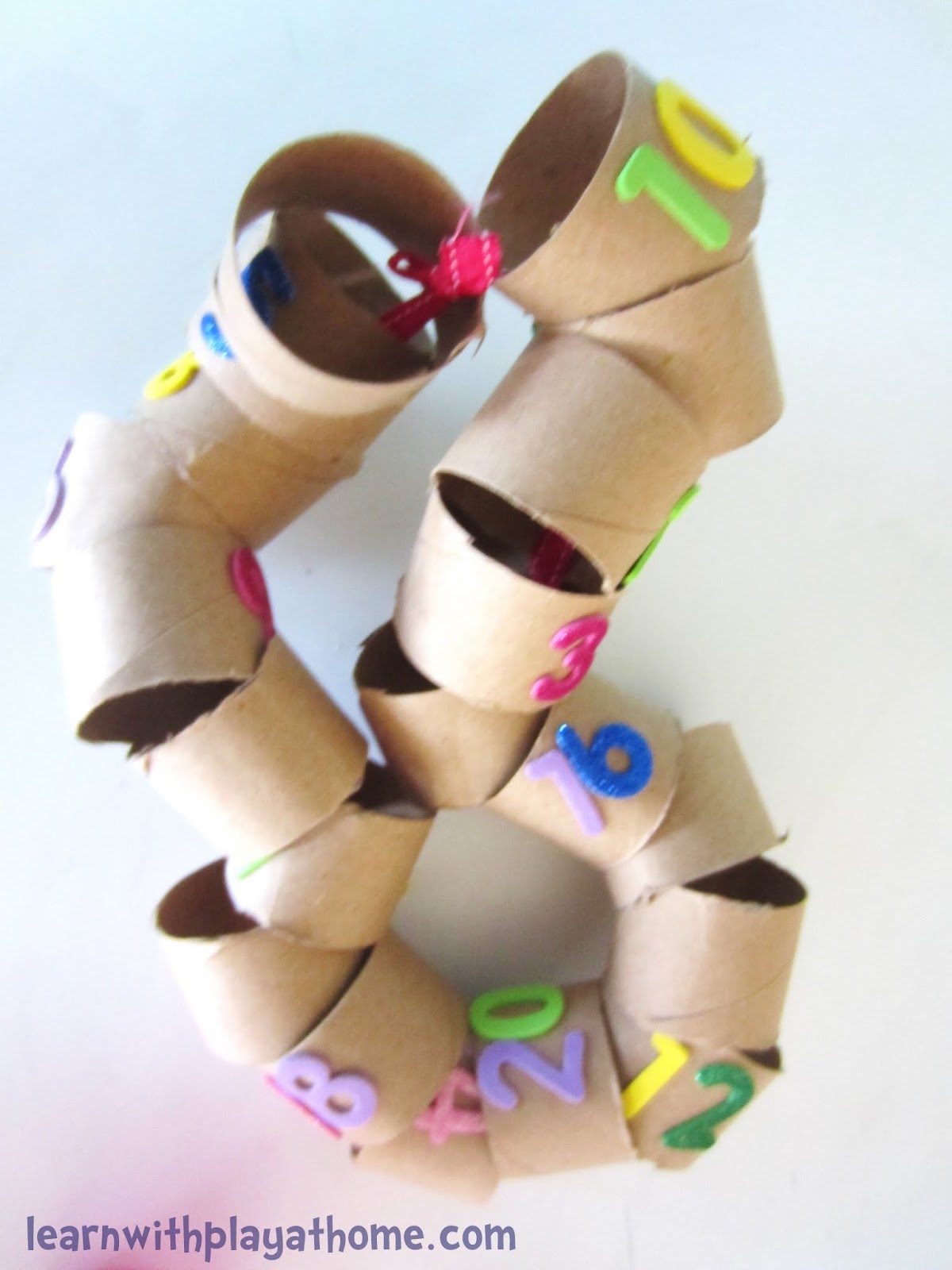
Number Recognition & Ordering with Paper Tubes. Playful Maths

Feb 15, 2013

maths for kids, fun maths, numeracy, maths activity


Welcome back to the "Playful Maths" weekly series brought to you by


Together, let's make MATHS FUN!

........................................


Last week we brought you 2 great maths activities using paper tubes.

This week we bring you another 2 activities using Paper Tubes. 


Today's activity from us focuses on "Number Recognition and Ordering" 


This activity also includes aspects of countingone-to-one correspondence, counting-on, sorting and fine motor skills.


Ages: 2+
(M has just turned 4. See the bottom for handy tips to Extend or Simplify to meet your child's needs)


Materials: Paper Tube cut into smaller pieces (we used 1 wrapping paper tube for this), Foam number stickers.
Optional: Counters, playdough & chopstick.


Sorting though numbers to find the right numbers.


Fine motor skills to peel off sticker backing


Sticking on the numbers. We focused on teen numbers. 


Counting on to figure out which number needs to be made next.


Ordering to ensure all the required numbers are made.


Once they are all made. It's up to you how you use this fun manipulative.
Just making them includes tons of maths learning and practice which children need in order to consolidate their understanding of numbers.


Here are some ways you could use your Paper Tube Numbers


Mix them all up and find the numbers one by one and put them in order from smallest to largest.


We had great fun building with them. Adding extra elements of balance and coordination


Add counters, choose one of your Paper Tube Numbers and count out the corresponding amount of counters.


Children could fill the inside of each Paper Tube Number with the corresponding amount of counters/pompoms etc by counting them out..


Ordering vertically was lots of fun. 
Stick a chopstick (or any stick etc) into playdough and thread away.


Choose any number and have the child count-on from that number and thread on the next numbers.
You can have children count and thread numbers backwards or forwards depending on which way they're ordering.


When you're done with your Paper Tube Numbers, thread them onto a piece of string, tie the ends and they're ready for you to get out next time.


Handy Tips:


- Simplify this activity by starting with numbers 1-3. Include higher numbers up to 10 as they are able.
(We focussed on teen numbers as that's where my child needs more work. We made a whole set though)


- You can Extend this activity in many ways:
  • Make higher numbers as required
  • Use single numbers on each tube and then place tubes together to create new numbers
  • Use the number tubes to practice addition, subtraction etc
  • Have children paint or write the numbers on the tubes themselves

- Mix it up by sticking the numbers on the tubes with them horizontally instead. They can then be threaded on rope or a broom handle, etc, horizontally. (Much harder to build with! haha)


- To learn new skills and to consolidate their understanding, children need to experience opportunities to practice these same skills over and over again. You will find many of our Maths activities practice the same skills using slightly different materials. This is about making it fun and keeping it interesting for kids. Then, they'll want to learn!


- Here are our 2 Paper Tube Activities from last week from both Learn with Play at home and The Imagination Tree
(click on the pictures to go to the posts)


- Playful Maths. Below are the Egg Carton Activities from both Learn with Play at home and The Imagination Tree
(click on the pictures to go to the posts)


Don't forget to join us next week for the latest Playful Maths activities.... with Plastic Bottles!


Are there any Everyday Materials that you'd like to see us use? 
Mention it in the comments and we'll see what we can come up with!


Happy playing,
Debs :)

Follow the entire series on our


-----------------------------------


Look where else we are. Are you following along? :)
New Here? Subscribe to get all activities sent directly to you
Enter your email address:


Delivered by FeedBurner

Continue reading...