Showing posts with label game. Show all posts

Acorn Number and Balancing Game

May 10, 2013


Welcome back to the "Playful Maths" series brought to you by


Together, let's make MATHS FUN!

............................................................................................................


This week we bring you another 2 Playful Maths Activities using Natural Materials. 

In this activity we are focusing on counting and balancing.
Other skills involved include fine motor, coordination, subitising, counting-on, ordering etc.


Continue reading...


Egg Carton Maths. Toddlers to School Age

Oct 5, 2012

maths for kids, number activity

Here I'll show you a basic Maths game that's easy to set up and can be easily simplified and extended to suit your child's needs.

Use this fun game to help with basic number recognition, number matching, counting, one-to-one correspondence, building, representation, addition, subtraction and more.

Ages- 2-6+
(M is 3.5 and currently working on teen numbers. See the bottom of the post for Handy Tips to help simplify or extend to meet your child's needs)

Materials: Empty Egg Carton, Sticker Dots, Marker, Pompom (or counter/paperclip etc), blocks(counters)


Write numbers in each space of the egg carton (we focused on teen numbers)


Write the same numbers on sticker dots


Have your child find and match the corresponding numbers. This ensures your child is familiar with all the numbers before starting the game as well as working on their matching skills, fine motor skills and number recognition.


When all the stickers are in, pop the pompom (or whatever you're using) and close the lid


And..... SHAKE! :)


Whatever the pompom lands on, have your child identify and make that number using and counting their blocks.


The number 17. Talk about the number. Look at the visual representation.
Go again!


Handy Tips:

- Simplify this activity by focusing on single numbers. You could use a half sized egg carton (the one pictured was painted by my daughter). Have your child decorate their egg carton to make it a special number shaker. If you wish, leave out the building of the visual representation of the number and just focus on the number recognition.
- Extend this activity by focusing on higher numbers or by putting in 2 pompoms (shakers) and having your child add the 2 numbers together, find the difference between the 2 numbers, subtract the lower number from the higher number, identify lower or higher, find and name a number between the 2 numbers etc.

- Mix it up by using this same method to learn letters, sight words etc.

- Instead of a pompom, something that allows children to see the number underneath still (like a paperclip) could be a good alternative.

- Listen to your child talk as they go through their experiences. This will help you determine where they are at with their learning, knowledge and understanding and help you to develop the activity (or future activities) to their level and interests. If they are breezing through single numbers then consider trying teen numbers and so on.

- Ensuring that there are some numbers that your child is already familiar with will help them feel more confident about the game and allow them to experience successes during the game.


Happy playing,
Debs :)


New Here? Subscribe to get all activities sent directly to you
Enter your email address:


Delivered by FeedBurner

Are you on Facebook? We are and we'd love to see you there. You can also find us on Pinterest, Twitter  and G+ too. :) 

Continue reading...


Recycling Sorting Activity + Free Printable Recycling Signs & ebooks

Jul 19, 2012

It is week 5 of the MeMeTales Readathon and this week the theme is Earth/Green. There are 2 free ebooks on the theme that you can read. "What Does It Mean To Be Green?" and "Let's Go Chipper!"
You can go HERE to read these books with your kids and to see more info on joining the Readathon. (It's Free!)
Did you know that in Week 1, 2, 3 and 4, over 5500 kids joined the Readathon?! That means they've donated over 5500 meals to hungry kids via FoodForEducation.org and that kids read 59,838 books!
Pretty impressive! 
After reading these books we had a discussion on what it means to be "green" and the ways that we try to be "green" at our house.
Older kids could make a list.


Being that we do a lot of crafts and use a lot of recycled goods, we always have a full tub of clean/safe recyclable materials.
I thought that while learning about being green, we could also incorporate some Early Numeracy, sorting & categorising skills and so this easy, fun activity was born.
learn with play at home, kids activity, recycling activity, memetales

Ages- 2-6+ (Can be extended for older school age children as well)
Materials: Recycling Labels (click for free printable), Recyclable goods (paper, plastic and glass)
Optional: Tubs/Boxes etc for sorting into (you can see I used some large plastic dishes)


Our recycle box with our usable materials.

Attach your labels to wherever you'd like the recyclable goods to be sorted.
(Extra: you could get the children to make their own labels or colour in the ones I've provided)


Maddie (3.5) was so eager to start she could barely wait for me to get set up


Reading/sounding out the words on the labels meant she knew where each item was intended


Diving in!


She declared that "sorting is fun!"


Once done, we could see our most popular recyclable materials and the ones that we don't tend to use as much of. Ask your child why they think this is?


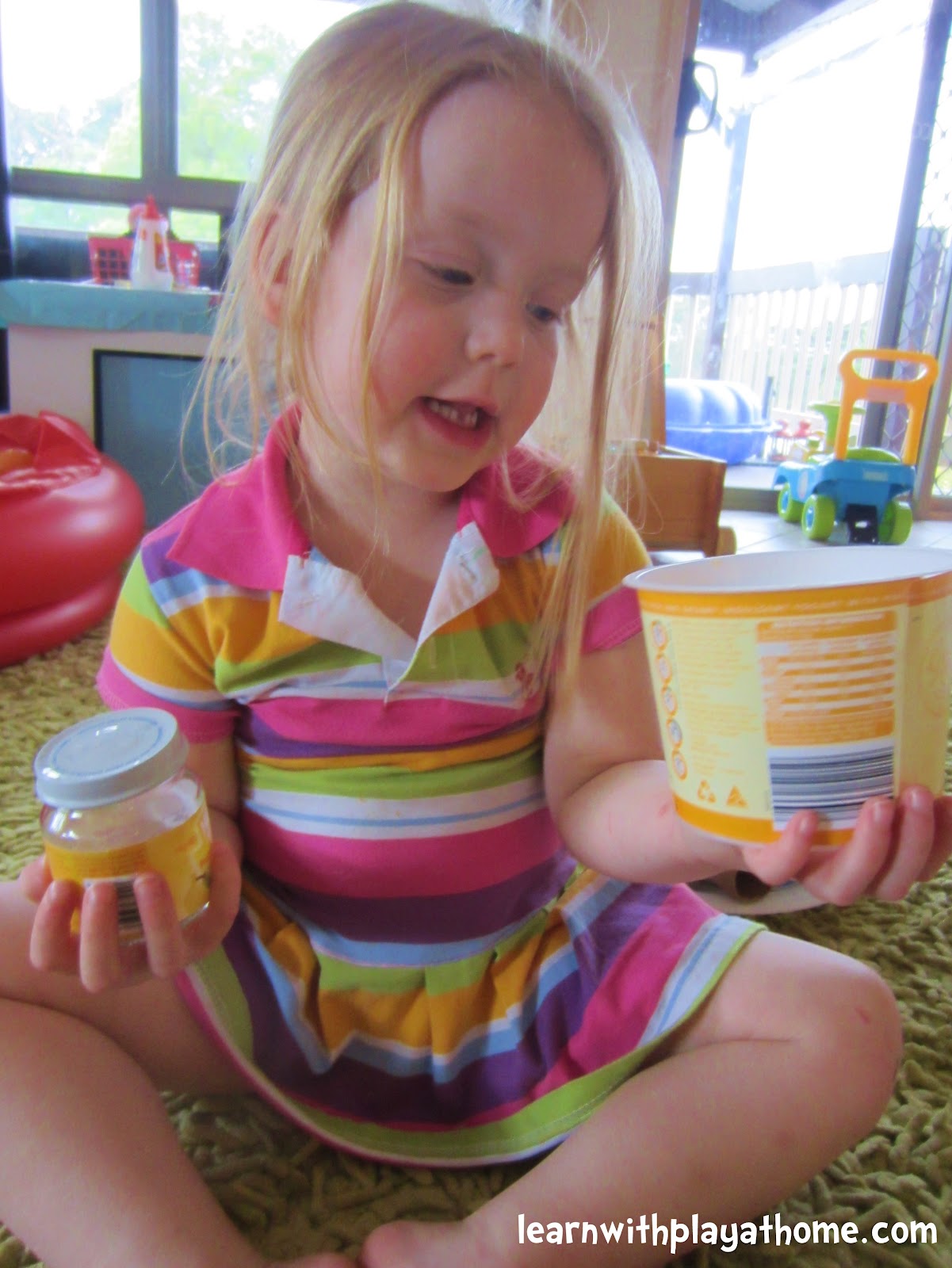
Added Math skills. "Weighing" and comparing a larger plastic tub and a small glass jar.
Which do you think was heavier?
(Talk about heavier, lighter etc)


Handy Tips:

- Simplify this activity by assisting your child to sort the different materials into the 3 groups. Talk about how they can tell the difference

- Extend this activity by having your child sort and categorise unassisted. Ask your child to explain to you the difference between the materials. Can they feel a difference in weight? Can they hear a difference when tapping the items? Etc. Have your child brainstorm uses for the recycled good.

- Mix it up by making a pretend recycling truck out of a cardboard box and “transporting” the recycled goods from the starting point to their separate groups. Add gross motor skills by having these at either ends of the room so they have to travel.

- Have more fun by providing some sticky tape for the children to get creative with the recyclable goods once you’ve finished sorting and categorising them.

- Brainstorm all the ways that they “Go Green” around the house and out and about

- Talk with your child about what they are doing. This will help them understand the physical and mental processes they are going through as well as giving them the vocabulary to describe it.

- Use new language and descriptive words like, "recycle" “conserve” etc. This will help with their language development.


Happy playing,
Debs :)


New Here? Subscribe to get all activities sent directly to you
Enter your email address:


Delivered by FeedBurner


Are you on Facebook? We are and we'd love to see you there. Hey, we're also on Twitter now too. :) 


Continue reading...


Building with Plastic Plates, Cups and Bowls

Jul 11, 2012


activity for kids, building game


Children love to build. It's something to do with the challenge, the skill and probably the knocking down, that makes it such an appealing activity for kids. It's not hard to find things around your house (other than blocks etc) that your children could build with, and today we raided the plastics cupboard to give it a go.


You will need some plastic plates, cups and bowls (or whatever you have on hand really)
I got these from KMart ages ago and at the time they were $3 each set. I think they may be $2 now!


All I did was put them on the floor. Job done, haha. 
Now leave it up to your child to figure out what to do.


It wasn't long before she was building!


That naughty gravity!


The challenge, use ALL of them in one tower


What goes up...


Handy Tips:

- Simplify this activity by just focussing on balancing as many as your child is capable of. Provide a stable surface to begin on.

- Extend this activity by challenging your child to use every plastic item they have in the one tower. See if they can build 2 towers that they can join together somehow. Include a focus on colours and patterns as well.

- Mix it up by providing other plastic items like various shaped and sized containers, funnels, bottles etc to provide different challenges.

- Make your child aware of the problem solving they are doing. "How are you going to get the bowl to balance on the cup?" "I love how you turned the cup upside down to balance it on top of another cup" etc


- Instead of always giving your child directions as to how they are expected to play, I like to mix it up and create "invitations" to play where children can explore and figure out for themselves what they can do. This type of open-ended activity allows the child to take the activity to a level they are comfortable with while giving them the freedom to explore different angles. Your child may come up with other fabulous games/activities with some plastic pieces.


- Use new language and descriptive words when talking to your child about what they are doing, like, "balancing" and "gravity" This will help with their language development and conceptual understanding.


Happy playing,
Debs :)


New Here? Subscribe to get all activities sent directly to you
Enter your email address:


Delivered by FeedBurner


Are you on Facebook? We are and we'd love to see you there. Hey, we're also on Twitter now too. :) 


Continue reading...


Soft Toy Toss

May 25, 2012


If you have a mountain of soft toys at your house like we do perhaps using them for some gross motor development  (otherwise known as, a fun and easy indoor throwing game) might appeal to your little one.

kids gross motor skill game, throwing practice


All you need are soft toys, a piece of masking tape and a toy bucket/basket/laundry hamper etc.


 Use your masking tape (or anything you have on hand, a skipping rope for example etc) to make a line for your child to stand behind. 


 She practiced throwing over-arm


Jumping for joy after getting it in


 Practicing her under-arm throw


Handy Tips:

- Simplify this activity by having the tub/bucket etc. much closer and using instruction and directions to help your child learn to throw. Encourage them to watch where they want the toy to land; follow through with their arm in the direction they are trying to throw etc

- Extend this activity by moving the tub further away from your child. Ask them questions about the different toys they are throwing. Why did that toy only land that far when you threw it the same as the previous toy? This engages their thinking and encourages them to think about the most effective toss for different types of toys. Some toys are heavier, some are lighter, bigger, smaller etc. This makes a difference to how they need to be thrown and the force behind the toss. Discuss this with your child. You could also incorporate some measuring to see how far away the tub is from the line and how much further away you can move it after each level.

- Practicality- Using a larger space in your house for something like this is a good idea and just remembering not to have them aiming towards your finest Ming vase goes without saying :) Perhaps reminding them that this is a set up activity and that we don't play this game inside with other items or without permission.

- Control- Encourage them to demonstrate control. If they can't manage the control and they aren't actually aiming for the tub etc. perhaps try again at another time. This will save your sanity (and house).

- Skills- reinforcing the gross motor skills and hand eye coordination needed for this task is important so that your child can improve their skills.

- Keep Playing- Move the tub further and further away from your child to challenge them until they can no longer make the distance. Learn with them. Do they need to adjust their throwing style for a further distance?


Debs :)


Look where else we play too. Come and play with us :)
New Here? Subscribe to get all activities sent directly to you
Enter your email address:


Delivered by FeedBurner
Continue reading...


Alphabet Order Game

May 16, 2012


This is a super easy and quick game to set up that includes singing and will challenge your child's memory and help them with their letter recognition.

Your child should be able and ready to play this game if they know how to sing the alphabet and appear to have an interest in letters. To challenge further or play the game in a different way, see the Handy Tips at the bottom.

To play this game you will need a set of alphabet cards or books. You print off a set here for free if you don't have any or you could do a quick google search for ones that appeal to you (there are tons available) or simply make your own in Microsoft Word or other publishing progams.


alphabet ordering game, fun letter activity, letter game, letter activity

So proud!


- Place all the cards/books in a big pile. Let your child rummage through them and give them a good mix up

- Sing the alphabet song with your child and then ask them what the first letter of the alphabet is (Repeat the song if needed until your child figures out that Aa is the first letter)

- Let your child find the letter Aa. If they are struggling, try giving them hints until they find it (eg. The capital A has a pointy top. etc or use colour hints if appropriate or Show them the letter Aa in a book or some other form of print as an example and have them find the match)

- Once they've found the Aa and put it aside, ask them what the next letter of the alphabet is and repeat the singing and hints etc until they have found it and put it beside the Aa.

- Repeat until your child has correctly identified and put in a line the entire alphabet. Well done!


Handy Hints

- To simplify this activity, have your child identify which is the next letter that needs to be found by singing the alphabet (and pointing along) and then help them find it (maybe make it a race?). Show them the letter then put it in the line and sing the alphabet again while pointing to the line and have them tell you which is the next letter to be found. Remember to make it fun!

- To extend this activity, try including letter sounds and words as well. What is the first letter of the alphabet? What sound does it make? Can you think of a word that begins with that sound? etc.

- As your child sings the alphabet, have them point to each of the corresponding letters they've already found to help reinforce the connection between the letter name and the symbol.

- Mix it up. Try playing the same game but this time call it, "Find the missing letter." Take one of the letters out and have your child try to identify the missing letter by using the same singing and finding technique.

- If your child loses interest half way through, don't push it. Just leave it and pick it up from the letter you were up to another time when they are interested again. Pushing and forcing learning at this early age level won't help your child develop a positive association with letters and learning. If anything, it could have the opposite effect. Remember to make learning FUN.


Debs :)

If you haven't come over to play with us on facebook yet, we'd love to see you there. Hey, we're also on Twitter now too. You can also subscribe (top right) so that you don't miss any fun activities.
Continue reading...


Shopping Trip Number Hunt

Apr 11, 2012


A little while back, due to an over-enthusiastic run-in hug with Daddy (her fault, not his), my little 3 year old lost a tooth! *sob*
Thankfully she was less upset over it than I was and after receiving $5 from the Tooth Fairy I decided we'd turn this unfortunate event, into a fun Maths learning excursion.

I decided to help her learn her numbers, (one at a time) with a fun shopping trip to spend the $5. Due to her age we focused mainly on number recognition while also touching on money and very simple addition.

Ages: 2+
(See ideas at the bottom to Extend or Simplify to meet your child's needs)


game to help learn numbers, game using money, place value, addition game, shopping game
 As the focus of this trip was learning about the number 5, I gave her a $5 note (as opposed to, say 5, $1 coins) because it had the number 5 on it.


 We went to our local K-Mart as I knew that their price labels are very clear and easy to spot the numbers. Well, she found a 5 straight away (Therefore she could buy this, right?... nope) so we had the chance to talk about the preceding number and how that made it a different value, etc. This was practice recognising other numbers as well as learning about place value.


 It didn't take long for her to start spotting the 5's (on their own) all over the place


 But, what was she to buy? It was too hard to choose just 1 thing so this is where we brought the simple addition in. I exchanged her $5 note (we'd succeeded in learning to recognise the number 5 by now) for 5, $1 coins... allowing her the freedom to purchase more than one item.


This is where the simple addition came in. She finally decided on a $3 pack of markers and a $2 light-up pen. 3 and 2 together make 5! Using dollar coins for this allowed her to physically manipulate the coins to see how the addition worked and see exactly what she could buy.


Even months on from this activity, she will still inform me of any 5's she notices on price tags. They are everywhere! lol


Handy tips:

- You could use this for any number and play it while doing any kind of outing.

- Your child doesn't need to purchase anything. That just gave it more meaning and relevance for us, but you could always just play a game to see who could spot the most of a chosen number etc.

- Change the number each time you go out to learn all the numbers.

-  Repeat numerous times. Some children will need very few exposures to something before they have learnt and understood it, others will need the information reinforced many times before it's committed to memory. Each child is different so work to your child's abilities.

- To extend this activity, set your child different challenges with the money (eg, find me 2 items that add up to that amount etc) and start to focus more on addition and place value

- To simplify this activity, stick to one number and focus on helping your child to recognise it. Leave out any addition etc


Happy playing,
Debs :)


Look where else we are. Are you following along? :)
New Here? Subscribe to get all activities sent directly to you
Enter your email address:


Delivered by FeedBurner

Continue reading...